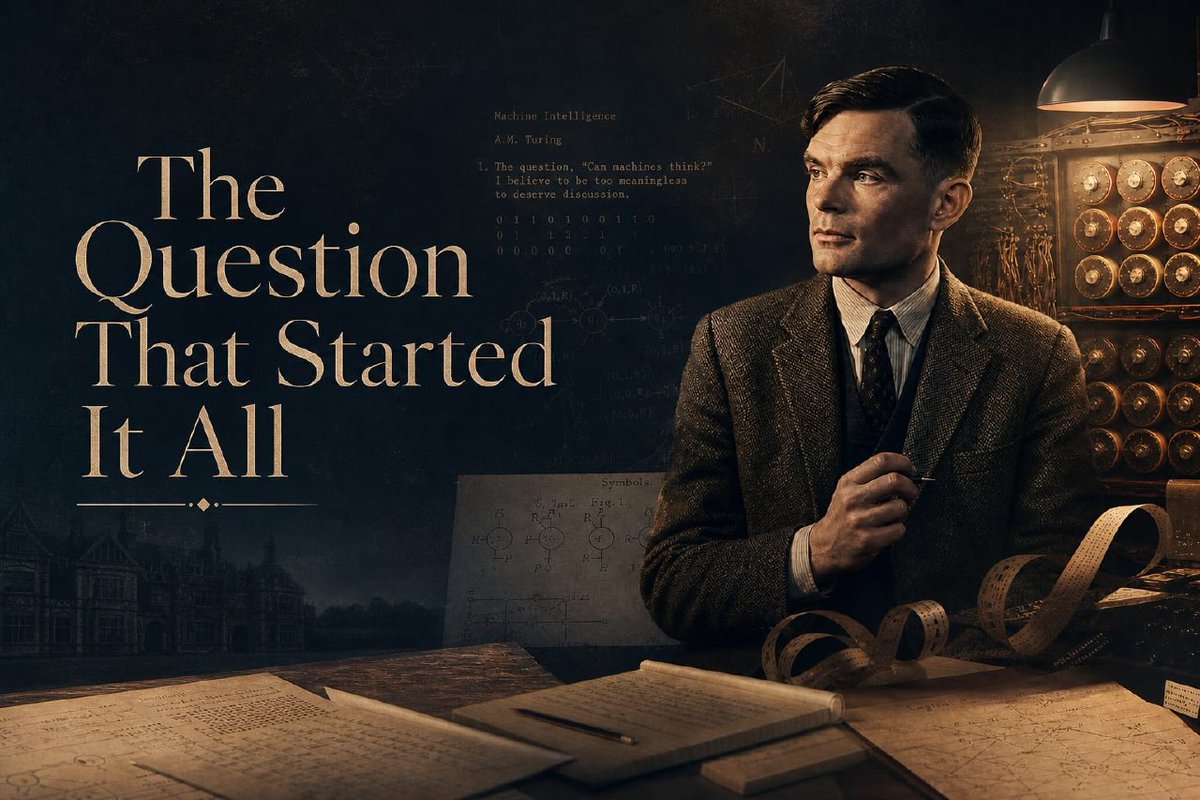
What did Alan Turing mean by asking whether machines can think?
Turing did not try to settle the meaning of thought with a single definition. In his 1950 paper “Computing Machinery and Intelligence”, he proposed a practical change of question: instead of asking what thinking must be, what evidence would show that a machine could imitate human conversation convincingly?
That move from an abstract question to a testable situation is the most useful business lesson. Before adopting AI, define what useful performance would look like in the actual workflow.
From philosophy to a testable idea
Turing’s paper introduced what he called the imitation game. The experiment did not prove that a machine had a human mind. It created a way to discuss and test machine behaviour without waiting for agreement on consciousness or the perfect definition of intelligence.
This distinction matters today. A system can produce fluent language without understanding a company as a person does. It may still be useful, but only when its sources, permissions, review points and responsibilities are clear.
What Turing did — and did not — predict
Turing did not create the whole field of artificial intelligence, and his 1950 paper was not a prediction of today’s commercial chatbots. His contribution was a method: turn a difficult question into a situation where performance can be examined.
The term “artificial intelligence” was coined later in the proposal for the 1956 Dartmouth Summer Research Project. Keeping those milestones separate makes the history more accurate and the business lesson clearer.
What can businesses learn from Turing?
Make the question practical
Instead of asking “What can AI do?”, ask “What useful result should this workflow produce?” Define the input, the output, the acceptable error rate and the point where a person must review the result.
Do not confuse imitation with understanding
Fluent language is not proof of human-like understanding. Use source material, retrieval boundaries, tests and human review to keep the system tied to the real business context.
Keep judgment where the cost of error is high
AI can prepare a draft, classify information, summarise a conversation or suggest the next step. A human should remain responsible for important external actions when money, reputation, safety, rights or relationships are involved.
A practical test for an AI use case
Before adding a tool, write down:
- The business task and its current owner.
- The result that would count as useful.
- The examples that represent normal and difficult cases.
- The failure that would be unacceptable.
- The evidence and approval needed before the system acts.
- The metric that will show whether the process improved.
This is the modern version of Turing’s useful move: replace a vague claim with an observable test.
Why this still matters
The most valuable lesson from Turing is not a prediction about machines. It is a way to ask better questions. AI becomes useful to a business when the question is specific enough to test, the responsibility is clear enough to manage and the result is valuable enough to measure.
Sources
Alan Turing, “Computing Machinery and Intelligence” · Dartmouth: AI coined at Dartmouth · NIST AI Risk Management Framework
¿Qué quería decir Alan Turing al preguntar si las máquinas pueden pensar?
Turing no intentó resolver el significado del pensamiento con una única definición. En su artículo de 1950 “Computing Machinery and Intelligence”, propuso cambiar la pregunta: en lugar de decidir qué debe ser pensar, ¿qué evidencia mostraría que una máquina puede imitar una conversación humana de forma convincente?
Ese paso de una pregunta abstracta a una situación que se puede probar es su lección más útil para una empresa. Antes de adoptar IA, define cómo sería un rendimiento útil dentro del flujo real.
De la filosofía a una idea comprobable
El artículo de Turing presentó lo que llamó el juego de imitación. El experimento no demostraba que una máquina tuviera una mente humana. Ofrecía una forma de analizar el comportamiento de una máquina sin esperar un acuerdo sobre la conciencia o una definición perfecta de inteligencia.
La distinción sigue siendo importante. Un sistema puede producir un lenguaje fluido sin comprender una empresa como lo hace una persona. Puede ser útil, pero necesita fuentes, permisos, puntos de revisión y responsabilidades claras.
Qué predijo Turing — y qué no
Turing no creó por sí solo todo el campo de la inteligencia artificial y su artículo de 1950 no fue una predicción de los chatbots comerciales actuales. Su contribución fue un método: convertir una pregunta difícil en una situación donde el rendimiento pudiera examinarse.
El término “inteligencia artificial” se acuñó después, en la propuesta del Proyecto de Investigación de Verano de Dartmouth de 1956. Separar estos hitos hace la historia más precisa y la lección empresarial más clara.
¿Qué pueden aprender las empresas de Turing?
Convertir la pregunta en algo práctico
En lugar de preguntar “¿Qué puede hacer la IA?”, pregunta “¿Qué resultado útil debe producir este flujo?”. Define la entrada, la salida, el margen de error aceptable y el punto en el que debe revisar una persona.
No confundir imitación con comprensión
El lenguaje fluido no demuestra una comprensión humana. Usa fuentes, límites de recuperación, pruebas y revisión humana para mantener el sistema conectado con el contexto real del negocio.
Mantener el criterio humano cuando el error cuesta caro
La IA puede preparar un borrador, clasificar información, resumir una conversación o sugerir el siguiente paso. Una persona debe seguir siendo responsable de las acciones externas importantes cuando están en juego el dinero, la reputación, la seguridad, los derechos o las relaciones.
Una prueba práctica para un caso de uso de IA
Antes de añadir una herramienta, escribe:
- La tarea y la persona responsable.
- El resultado que se consideraría útil.
- Los ejemplos normales y difíciles.
- El fallo que sería inaceptable.
- Las fuentes y la aprobación necesarias antes de actuar.
- La métrica que mostrará si el proceso mejoró.
Esta es la versión actual del movimiento útil de Turing: sustituir una afirmación vaga por una prueba observable.
Por qué sigue siendo importante
La lección más valiosa de Turing no es una predicción sobre las máquinas. Es una forma de formular mejores preguntas. La IA se vuelve útil cuando la pregunta se puede probar, la responsabilidad se puede gestionar y el resultado se puede medir.
Fuentes
Alan Turing, “Computing Machinery and Intelligence” · Dartmouth: AI acuñada en Dartmouth · NIST AI Risk Management Framework
Wat bedoelde Alan Turing met de vraag of machines kunnen denken?
Turing probeerde de betekenis van denken niet met één definitie vast te leggen. In zijn artikel “Computing Machinery and Intelligence” uit 1950 stelde hij een praktische verandering voor: in plaats van te vragen wat denken precies is, welke aanwijzingen zouden laten zien dat een machine een menselijk gesprek overtuigend kan imiteren?
De stap van een abstracte vraag naar een testbare situatie is zijn nuttigste les voor bedrijven. Definieer voordat je AI adopteert hoe nuttige prestaties er in de echte workflow uitzien.
Van filosofie naar een testbaar idee
Turing introduceerde in zijn artikel wat hij het imitation game noemde. Het experiment bewees niet dat een machine een menselijke geest had. Het bood een manier om machinegedrag te bespreken en te testen zonder eerst overeenstemming te bereiken over bewustzijn of een perfecte definitie van intelligentie.
Dat onderscheid is vandaag nog belangrijk. Een systeem kan vloeiende taal produceren zonder een bedrijf te begrijpen zoals een mens dat doet. Het kan toch nuttig zijn, maar alleen met duidelijke bronnen, rechten, controlepunten en verantwoordelijkheden.
Wat voorspelde Turing wel — en niet?
Turing creëerde niet in zijn eentje het hele vakgebied van kunstmatige intelligentie en zijn artikel uit 1950 voorspelde de huidige commerciële chatbots niet. Zijn bijdrage was een methode: een moeilijke vraag omzetten in een situatie waarin prestaties onderzocht kunnen worden.
De term “artificial intelligence” werd later gebruikt in het voorstel voor de Dartmouth Summer Research Project van 1956. Door deze mijlpalen apart te houden, blijft de geschiedenis nauwkeuriger en de zakelijke les duidelijker.
Wat kunnen bedrijven van Turing leren?
Maak de vraag praktisch
Vraag niet alleen “Wat kan AI?”, maar “Welk nuttig resultaat moet deze workflow opleveren?”. Definieer de invoer, de uitvoer, de aanvaardbare foutmarge en het moment waarop een mens moet controleren.
Verwar imitatie niet met begrip
Vloeiende taal is geen bewijs van menselijk begrip. Gebruik bronnen, grenzen aan de context, tests en menselijke controle om het systeem aan de echte bedrijfscontext te koppelen.
Behoud menselijk oordeel waar fouten kostbaar zijn
AI kan een concept voorbereiden, informatie classificeren, een gesprek samenvatten of een volgende stap voorstellen. Een mens moet verantwoordelijk blijven voor belangrijke externe acties wanneer geld, reputatie, veiligheid, rechten of relaties op het spel staan.
Een praktische test voor een AI-use-case
Schrijf voordat je een tool toevoegt op:
- De taak en de eigenaar van het huidige proces.
- Het resultaat dat nuttig zou zijn.
- Voorbeelden van normale en moeilijke gevallen.
- De fout die onaanvaardbaar zou zijn.
- De bronnen en goedkeuring die nodig zijn voordat het systeem handelt.
- De metric die laat zien of het proces verbeterde.
Dit is de moderne versie van Turings nuttige beweging: een vage bewering vervangen door een observeerbare test.
Waarom dit nog steeds relevant is
De belangrijkste les van Turing is geen voorspelling over machines. Het is een manier om betere vragen te stellen. AI wordt nuttig voor een bedrijf wanneer de vraag testbaar is, de verantwoordelijkheid beheersbaar en het resultaat meetbaar.
Bronnen
Alan Turing, “Computing Machinery and Intelligence” · Dartmouth: AI coined at Dartmouth · NIST AI Risk Management Framework
Ready to find out what you can actually automate?