← All posts
AI-strategie·19 augustus 2026
Dartmouth 1956: Toen AI een vakgebied werd
Een mogelijkheid benoemen is nog niet hetzelfde als haar bruikbaar maken. Het verhaal van Dartmouth biedt een praktische les voor bedrijven die AI invoeren.
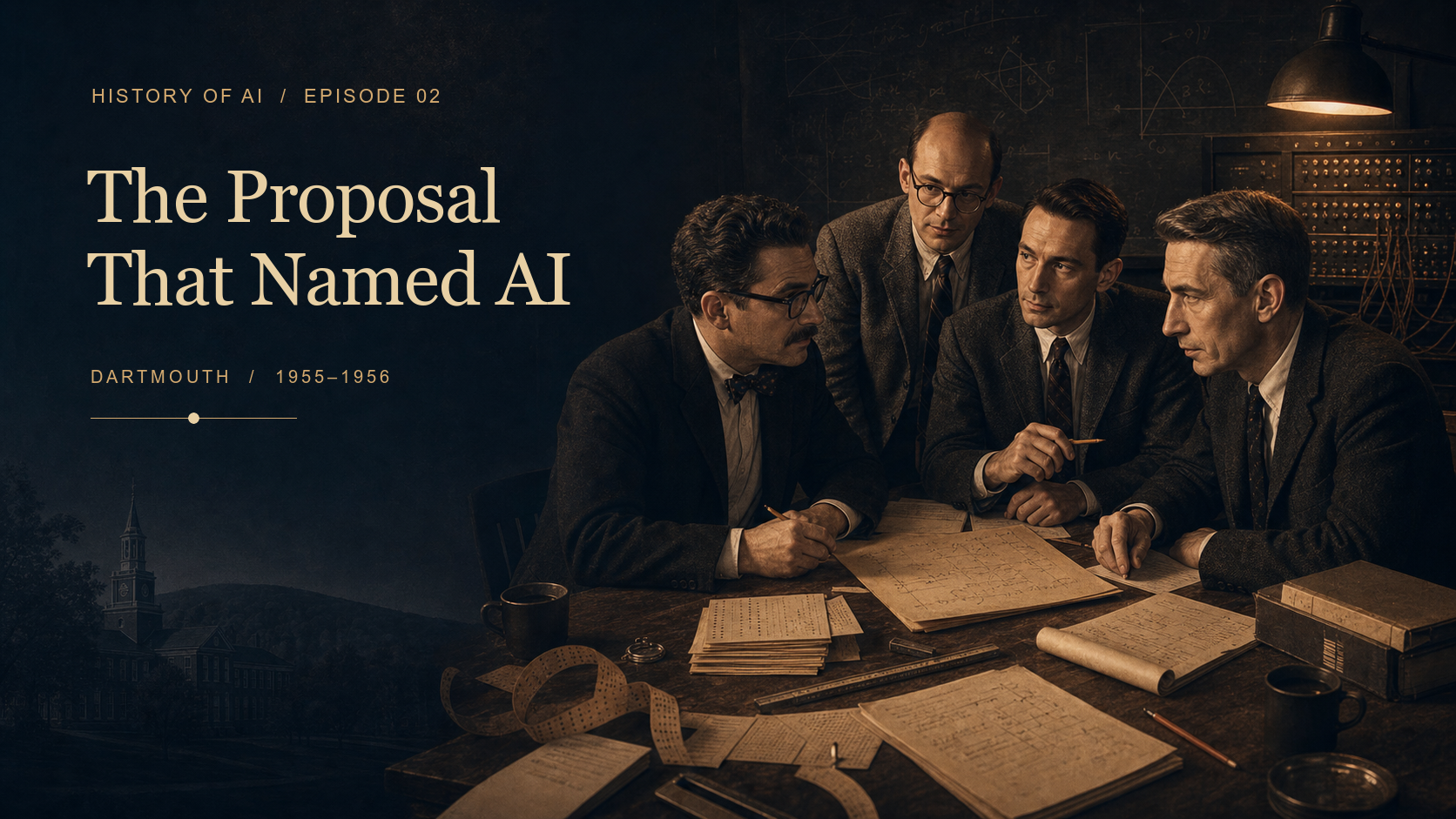
In 1955, four researchers proposed a summer study at Dartmouth College for the following year. John McCarthy, Marvin Minsky, Nathaniel Rochester and Claude Shannon believed that aspects of learning, reasoning, language and intelligence might be described precisely enough for a machine to simulate them.
The proposal was ambitious. The computers of the period were limited, expensive and nothing like the systems we now call AI. But the researchers were not only asking whether a machine could calculate faster. They were asking whether intelligence itself could be studied as something structured.
The proposal behind the summer study
The 1955 proposal described artificial intelligence as a problem that could be approached through formal analysis. It brought together ideas about language, abstraction, problem solving, learning and machine improvement.
Naming a capability is not the same as making it useful.
Dartmouth did not produce a finished AI industry. It helped gather researchers around a shared ambition and made that ambition easier to discuss, fund and pursue.
From possibility to capability
The same gap exists in business today. A new model, agent or automation platform may make something possible. That does not mean the capability is ready to become part of a dependable operation.
A convincing demo is not yet a workflow. A generated answer is not yet a reliable customer response. An impressive prototype is not yet a process that a team can use repeatedly, measure and improve.
What businesses can learn from Dartmouth
Start with a question worth organising
The useful starting point is not “Where can we add AI?” but “Which recurring part of the work is unclear, repetitive or difficult to improve?”
Define good output before choosing a tool
If a team cannot describe what a good result looks like, it is not ready to automate the process.
Design for responsible uncertainty
AI systems can prepare, classify, summarise and recommend. Important workflows need approval points, source references, exception handling and a record of what happened.
Measure the workflow, not the novelty
The value of an AI system is the improvement in a real business outcome: fewer hours lost, faster follow-up, fewer errors, clearer knowledge, better customer experience or more consistent delivery.
Where history becomes useful
The Dartmouth story shows the difference between naming a possibility and building a discipline around it. Businesses face the same task now: choose one useful workflow, define the outcome, build the smallest dependable system and keep human judgment where it matters.
What part of this work can be made clearer, measured and safely improved—and where must human judgment remain responsible?
That is how a capability becomes useful.
Sources
Dartmouth proposal (1955) · Stanford Encyclopedia of Philosophy
En 1955, cuatro investigadores propusieron un estudio de verano en Dartmouth College para el año siguiente. John McCarthy, Marvin Minsky, Nathaniel Rochester y Claude Shannon creían que aspectos del aprendizaje, el razonamiento, el lenguaje y la inteligencia podían describirse con suficiente precisión como para que una máquina los simulase.
La propuesta era ambiciosa. Los ordenadores de aquella época eran limitados, caros y muy distintos de los sistemas que hoy llamamos IA. Pero los investigadores no solo preguntaban si una máquina podía calcular más rápido. Preguntaban si la inteligencia podía estudiarse como algo estructurado.
La propuesta detrás del estudio de verano
El documento de 1955 planteaba la inteligencia artificial como un problema que podía abordarse mediante análisis formal. Reunía ideas sobre lenguaje, abstracción, resolución de problemas, aprendizaje y mejora de las máquinas.
Nombrar una capacidad no es lo mismo que hacerla útil.
Dartmouth no produjo una industria de IA terminada. Ayudó a reunir a investigadores alrededor de una ambición común y facilitó que esa ambición pudiera estudiarse, financiarse y desarrollarse.
De la posibilidad a la capacidad
La misma diferencia existe hoy en las empresas. Un nuevo modelo, agente o plataforma de automatización puede hacer algo posible. Eso no significa que la capacidad esté lista para convertirse en una operación fiable.
Una demo convincente todavía no es un flujo de trabajo. Una respuesta generada todavía no es una respuesta fiable para un cliente. Un prototipo impresionante todavía no es un proceso que un equipo pueda utilizar, medir y mejorar de forma repetida.
Qué pueden aprender las empresas
Empezar con una pregunta útil
La pregunta no es “¿dónde podemos añadir IA?”, sino “¿qué parte recurrente del trabajo es confusa, repetitiva o difícil de mejorar?”.
Definir el resultado antes de elegir la herramienta
Si el equipo no puede describir qué aspecto tiene un buen resultado, el proceso todavía no está preparado para automatizarse.
Diseñar para la incertidumbre responsable
La IA puede preparar, clasificar, resumir y recomendar. Los flujos importantes necesitan puntos de aprobación, referencias a las fuentes, gestión de excepciones y un registro de lo ocurrido.
Medir el flujo, no la novedad
El valor de un sistema de IA se mide en un resultado real: menos horas perdidas, respuestas más rápidas, menos errores, conocimiento más claro, mejor experiencia de cliente o una entrega más consistente.
Cuando la historia se vuelve útil
La historia de Dartmouth muestra la diferencia entre nombrar una posibilidad y construir una disciplina alrededor de ella. Las empresas se enfrentan hoy a la misma tarea: elegir un flujo útil, definir el resultado, construir el sistema fiable más pequeño posible y mantener el criterio humano donde importa.
¿Qué parte del trabajo puede hacerse más clara, medirse y mejorarse con seguridad, y dónde debe seguir siendo responsable el criterio humano?
Así es como una capacidad se convierte en algo útil.
Fuentes
Propuesta de Dartmouth (1955) · Stanford Encyclopedia of Philosophy
In 1955 stelden vier onderzoekers een zomerstudie aan Dartmouth College voor, die het jaar daarop zou plaatsvinden. John McCarthy, Marvin Minsky, Nathaniel Rochester en Claude Shannon geloofden dat aspecten van leren, redeneren, taal en intelligentie precies genoeg konden worden beschreven om door een machine te worden nagebootst.
Het voorstel was ambitieus. De computers van die tijd waren beperkt, duur en totaal anders dan de systemen die we nu AI noemen. Toch vroegen de onderzoekers niet alleen of een machine sneller kon rekenen. Ze vroegen of intelligentie zelf kon worden bestudeerd als iets gestructureerds.
Het voorstel achter de zomerstudie
Het voorstel uit 1955 beschreef kunstmatige intelligentie als een probleem dat formeel onderzocht kon worden. Het bracht ideeën samen over taal, abstractie, probleemoplossing, leren en het verbeteren van machines.
Een mogelijkheid benoemen is nog niet hetzelfde als haar bruikbaar maken.
Dartmouth leverde geen voltooide AI-industrie op. Het hielp onderzoekers wel om zich rond een gedeelde ambitie te organiseren en die ambitie bespreekbaar, financierbaar en onderzoekbaar te maken.
Van mogelijkheid naar capaciteit
Hetzelfde verschil bestaat vandaag in bedrijven. Een nieuw model, een agent of een automatiseringsplatform kan iets mogelijk maken. Dat betekent nog niet dat de capaciteit klaar is voor een betrouwbare bedrijfsvoering.
Een overtuigende demo is nog geen workflow. Een gegenereerd antwoord is nog geen betrouwbaar klantantwoord. Een indrukwekkend prototype is nog geen proces dat een team herhaaldelijk kan gebruiken, meten en verbeteren.
Wat bedrijven van Dartmouth kunnen leren
Begin met een vraag die de moeite waard is
De nuttige startvraag is niet “Waar kunnen we AI toevoegen?”, maar “Welk terugkerend onderdeel van het werk is onduidelijk, repetitief of moeilijk te verbeteren?”
Bepaal het resultaat vóór je een tool kiest
Als een team niet kan uitleggen hoe een goed resultaat eruitziet, is het proces nog niet klaar voor automatisering.
Ontwerp voor verantwoord omgaan met onzekerheid
AI kan voorbereiden, classificeren, samenvatten en aanbevelen. Belangrijke workflows hebben goedkeuringsmomenten, bronverwijzingen, uitzonderingsregels en een verslag van wat er is gebeurd.
Meet de workflow, niet de nieuwigheid
De waarde van een AI-systeem zit in een echt bedrijfsresultaat: minder verloren uren, snellere opvolging, minder fouten, duidelijkere kennis, een betere klantbeleving of een consistentere uitvoering.
Wanneer geschiedenis nuttig wordt
Het Dartmouth-verhaal laat het verschil zien tussen een mogelijkheid benoemen en er een discipline omheen bouwen. Bedrijven staan nu voor dezelfde taak: kies één nuttige workflow, definieer het resultaat, bouw het kleinste betrouwbare systeem en behoud menselijk oordeel waar dat ertoe doet.
Welk onderdeel van het werk kan duidelijker, meetbaar en veilig verbeterd worden—en waar moet menselijk oordeel verantwoordelijk blijven?
Zo wordt een mogelijkheid bruikbaar.
Bronnen
Dartmouth-voorstel (1955) · Stanford Encyclopedia of Philosophy
Ready to find out what you can actually automate?
Let's talk about your business.
Start the conversation